






When people picture dolphins in Hawaii, they usually imagine something playful and energetic: leaping, spinning, racing alongside boats in the morning sun. That image is accurate, but it only captures a small slice of what spinner dolphins actually do across a full day.
The daily life of a Hawaiian spinner dolphin is built around a tight, repeating cycle of hunting, traveling, resting, and socializing. Understanding that cycle changes the way you watch them entirely.
As the sun goes down over the Waianae Coast and the sky darkens, something shifts in the pods that have been resting in the shallow coastal bays all day. The animals begin to move. They leave the protected waters near shore and head offshore, swimming steadily toward deeper and darker water.
By the time full night falls, spinner dolphins are far from the coastline and hundreds of meters below the surface. This is where the work happens. For a complete picture of what that night actually looks like, see our guide to what spinner dolphins do all night →
Spinner dolphins are precision nighttime hunters. Their prey, small mesopelagic fish, squid, and shrimp, rises toward the surface each night as part of the ocean’s daily vertical migration. Dolphins follow this migration downward, using echolocation to locate prey in near-total darkness, then coordinate as a group to herd schools of fish into tight clusters before moving in to feed.
A healthy adult spinner dolphin needs roughly 15 to 20 pounds of food per night. Getting there requires sustained effort across several hours of deep diving, coordinated movement, and constant communication within the pod.
The middle of the night is when spinner dolphin hunting activity is most intense. Pods that numbered a few dozen animals during the daytime rest period may have merged with other groups, forming coordinated hunting units of a hundred or more animals working together in the dark.
This fission-fusion structure, in which pods break into small units during the day and merge into larger ones at night, is one of the defining features of spinner dolphin social organization. The same dolphins that rested quietly side by side in a shallow bay that morning are now functioning as a single coordinated hunting machine hundreds of meters below the surface.
Spinner dolphins can hold their breath for up to ten minutes and dive to depths of 200 to 300 meters in pursuit of prey. Each dive is followed by a return to the surface to breathe, then another descent. This pattern repeats across the night, with individual dolphins taking turns driving through prey schools and surfacing to recover.
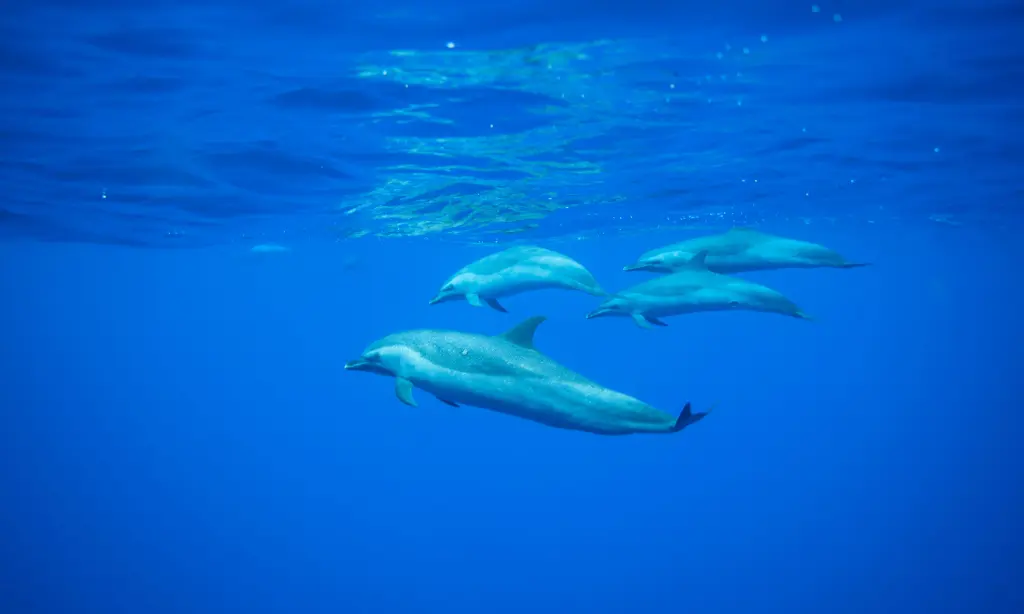
As the night winds down and the deep scattering layer begins its morning descent back into the depths, the hunting becomes less productive. Pods begin moving back toward shore, traveling steadily through open water as the sky starts to lighten.
By the time the first tour boats are leaving Waianae Boat Harbor, the dolphins are already close to the coast and beginning to settle into the shallow bays they left the evening before. The transition from nighttime hunter to daytime rester happens quickly and reliably, which is one reason early morning is consistently the best time to find spinner dolphins near shore.
What guests observe from the boat during a Dolphins and You tour are animals that have already completed a full night of deep-water hunting. The calm surface behavior, the slow movement, the synchronized breathing, the pods drifting together in the morning light, is what recovery looks like for one of the ocean’s most capable predators.
The morning hours are the heart of the spinner dolphin’s rest period. Pods settle into the calm, sheltered bays of the Waianae Coast and shift into a quieter mode of behavior.
Dolphins cannot sleep the way humans do. They practice unihemispheric slow-wave sleep, resting one half of the brain at a time while the other half stays active enough to keep them breathing, watching for predators, and staying with the group. One eye stays open. One eye closes. After a period, the sides switch. This half-sleep allows spinner dolphins to get real rest while remaining responsive to their environment.
During the morning rest period, pods typically break into smaller, quieter groups of familiar individuals. Movement slows to a gentle drift near the surface. Breathing becomes rhythmic and unhurried. Calves stay pressed close to their mothers, drafting in the hydrodynamic wake their mothers create to conserve energy.
But rest is not the only thing happening. Morning hours also involve significant social activity: gentle physical contact between pod members, signature whistle exchanges that reinforce individual bonds, and the playful spinning behavior that gives this species its name. The spinning leaps that visitors find so captivating are more than acrobatics. They serve as social signals, possible coordination cues, and perhaps simply expressions of the energy that builds as a well-fed pod begins to recover from the night’s effort.
Mothers with nursing calves are particularly attentive during the morning rest period. The shallow, calm waters of the Waianae Coast provide a sheltered environment where calves can practice swimming, observe adult behavior, and rest safely while the pod recovers around them.
By midday, some dolphins in the pod may begin showing signs of increasing activity while others continue to rest. This is the fission-fusion dynamic in reverse: the tightly grouped morning rest clusters begin to loosen, with some animals becoming more exploratory or social while others maintain slower, more restful movement.
Midday is also when the pod’s position along the coast may shift. Spinner dolphins do not stay anchored to a single location but move gradually along the Waianae shoreline, following conditions that suit their current needs.
Water temperature, visibility, and the presence of other marine life all influence where pods spend their middle-of-the-day hours. On calm, clear days, midday pods are often still visible from the surface, moving slowly and surfacing in regular rhythms.

As the afternoon progresses, the pod’s energy shifts again. Rest gives way to increasing movement. Animals that were barely breaking the surface a few hours earlier begin swimming with more purpose, socializing more actively, and gradually orienting offshore.
This afternoon transition is the mirror image of the dawn return. The same predictability that brings dolphins close to shore in the morning pulls them back out to sea in the evening. By sunset, most pods have left the coastal bays of the Waianae Coast and are heading offshore to begin the cycle again.
The reason they keep returning to the same stretch of West Oahu coastline is not habit for its own sake. It is because this particular combination of sheltered bays, deep offshore water, and reliable food supply fits their daily rhythm better than almost anywhere else on Earth.
Want to see dolphins in action during their morning playtime and discover their fascinating daily routine?
Book our morning dolphin-watching tour today and enjoy a front-row seat to the fun!
Dolphins and You · Oahu, Hawaii
The morning rest period is the most reliable window to see wild spinner dolphins close to shore. Join Dolphins and You on the Waianae Coast and watch them in the hours right after a full night of deep-water hunting.
4.9 ★
Google & TripAdvisor
35 yrs
in business
Wild
100% wild dolphins
Tours depart from Waianae Boat Harbor, West Oahu, where spinner dolphins gather every morning after a full night at sea.
